Showing posts with label nixie. Show all posts

15 August 2024

Fairchild Multimeter Model 7050


I bought a Fairchild 7050 multimeter because it has slightly larger than usual Nixies. There was no indication of its state, but I could count the three tubes in the pictures. It looked a bit dirty as visibile in the picture below.

Picture of a dirty Fairchild model 7050 multimeter
Picture by the seller.

When it arrived I tried powering it at half AC voltage, just in case, but nothing happened. There was no current draw as the power supply didn't sag a single Volt. As it was sold as a "low cost accurate 3-digit instrument" (quote from the manual), there is just one screw in the back keeping everything together. Also the AC cord is soldered to the board, there is no socket.

Once I could look inside I measured that the fuse was intact, so I moved to the ON/OFF switch and sure enough it did nothing: open in both positions. If everything else is OK, it will have to be replaced and shouldn't be too hard to find since it was a "low cost instrument" probably using very common parts.

I created a short across the switch and tried again the power-up sequence as before. At 120 Vac it wouldn't display anything, but there were no signs of smoke, overheating, smell, burns, exploded components, ... so we stepped to the nominal 220 Vac... whoa! It is working!

I did some tests and the readings agree with my other DVM's. Well, let's say they are in the ballpark but hardly within the 0.1% advertised in the manual. Thought there is no drift after the warm-up and nothing blew up after more than 60 minutes of doing something.

So, apart from cleaning, fixing the power switch and maybe trying to recalibrate it, this little beauty from the past should not present other challenges and is ready to go into service.

23 June 2023

An HP 5326B enters my lab

It was just a matter of waiting until I could buy an old/surplus/vintage HP device with Nixies for little money. Unknown conditions, of course.

I bought an HP 5326B Electronic Counter in Basaluzzo HAM flea market (June 2023) which was designed to measure 100 mV up to 50 MHz and display the result on 7x B5750 Nixies (or similar). It also has a 1000Vdc voltmeter measured using an internal V/F converter.

Display board of HP 5326B.
On a first visual inspection the unit was serviced once to replace a 1820-0119 IC that was actually rebuilt with TTL ICs! It had loose screws of the top cover, so I wasn't hoping for the best but I powered it up nevertheless.

Well, well, it sprang to life and seemed to give proper readings, so I needed to read the manual to check for proper operation and calibration check.

The unit is in proper working order. The stock 10 MHz reference oscillator is spot-on at least for the precision I can reach in my lab. The DVM might be reading 1% high my calibrated voltage source, but I'm comparing it to other uncalibrated, various era, less resolution devices.

I like the possibility to make it count events until the reset button is pressed, which means it can become a clock with very simple interfacing.

The rebuilt 1820-0119 does not implement leading-zero blanking so the 7th digit is always on. I'm even thinking of building a modern replacement of the counter+buffer pair 1820-0119/1820-0116 by means of a microprocessor. This way I regain the leading-zero blanking and I might even add the 8th digit option!

I played a little game: how far does it measure beyond the 50 MHz upper limit? I used the NanoVNA as a frequency generator using the "CW mode" (alternatively you set the Span to 0). I have no idea of the signal amplitude at this point but it reached 95.000 MHz! The counter is 9.3 kHz high (0.01% or 100 ppm).

A visual proof that with enough input signal the HP 5326B can count up to 95 MHz
HP 5326B measuring 95 MHz.


26 November 2022

The 4-weeks challenge: deliver a Nixie clock from scratch

Last weekend of October a curious teenager guest noticed the Nixie clock in our living room. The most eye-catching element was the short depoisoning routine that runs once a minute. B-5750 Nixies have their numbers 0-to-9 back-to-front, which is an even more eye-catching feature.

So I quickly explained him and his family some basics of these lovely tubes, showed them my lab/workshop/messy room and of course I told them I had designed and built that clock.

The next day I came up with a self-challenge: design and build a fully functional Nixie clock that I could give the teen at our next (and probably last for a very long time) meeting four weeks ahead.

With a small personal "library" of hardware design and AVR firmware I was quite sure I could get over all the small challenges inside this project:

  • design a working circuit and receive the PCB from the fabhouse
    • sub-task: fix the KiCAD footprint for the chosen ZM1020 Nixie
  • design a suitable case and get it 3D printed (this then turned to laser cut)
  • build it without easy access to my lab for the same period of time
  • write a user's manual

The PCB was designed with KiCAD and etched by JLCPCB. To save on board space and stay into the chosen round design I used a bare AVR ATmega uC with its internal 8 MHz clock; it also drives the voltage booster. On the board I included an ICSP header which is very useful if you're debugging or adjusting the firmware code. I used a ZM1020 round top view tube

While waiting for PCBs to arrive I learned how to use OpenSCAD to design the case, which is plain geometry applied to programming. I also risked to have no AVR microcontroller for the clock as the ATmega48 doesn't have enough program memory (or I would have needed to do heavy optimizations). I managed to unbrick a couple of ATmega168 that are enough for my firmware (wrong fuse settings).

The circuit diagram was correct. The PCB was suitable, meaning I kept HV and LV separated enough. The laser cut case (two plates) was perfect and I picked it at 3.5 weeks into the challenge. In the last week I did some firmware corrections and upgrades and today the clock has been delivered to a happy teenager.

Here it is!

Single Digit Nixie Clock with ZM1020


18 October 2022

HP 3734A Electronic Counter

I really enjoyed Mombarone HAM Fest (near Asti, Italy), October 2022. The visitors flow was relaxed and I could spend time looking above and below stands.

In a corner I spotted a device that supposedly contained Nixie tubes. The seller, who had a stand of regular wristwatches, said: "it's for the Nixies". It was wrapped in plastic, I could see it had physical damage. He asked 15€ but had no change, so I raised the swap to 20€, which is closer to the current ZM1022 quotation (2022AD). That's 4€ per tube, plus the transformer and .... a true HP device!

So I got an "HP 3734A Electronic Counter". The Nixies tested OK for gas but one side of the case has heavy damage with broken aluminium brackets! The plastic display bezel is broken as well as a corner of the protective glass (it is composed of an orange plastic sheet over a clear glass).

As looked from above it is also not square but a bit rhombic. Nothing a light hammer and a 3D printer cannot fix, right?

Since I had nothing to loose, I powered it up (with the right "163" cable). This was the pass mark to decide on fixing or scrapping the whole device (minus the Nixies).Well, the verdict is "fixing" since it did power up! Without smoke.


I haven't found a free PDF manual online, but it's not that hard to understand how it works, showing either a frequency or its period. Unfortunately it doesn't work even if the internal 100 kHz oscillator is runnng.

There is also a pulse counter function controlled with start/stop/reset buttons which obviously bypasses all signal conditioning and averaging circuitry. It counts either an EXTernal or and INTernal source. Well, selecting "INT" on the front knob combined with "INT" on the backside switch makes the counter use its own 100 kHz clock as source. Et voilĂ , Nixies were running as soon as I hit "START".

If the case can be re-aligned and rebuilt, there is enough working electronics to make a five digit clock. A big plus is that input/start/stop controls are available on the back panel too so everything can be hidden inside or behind. Nice!

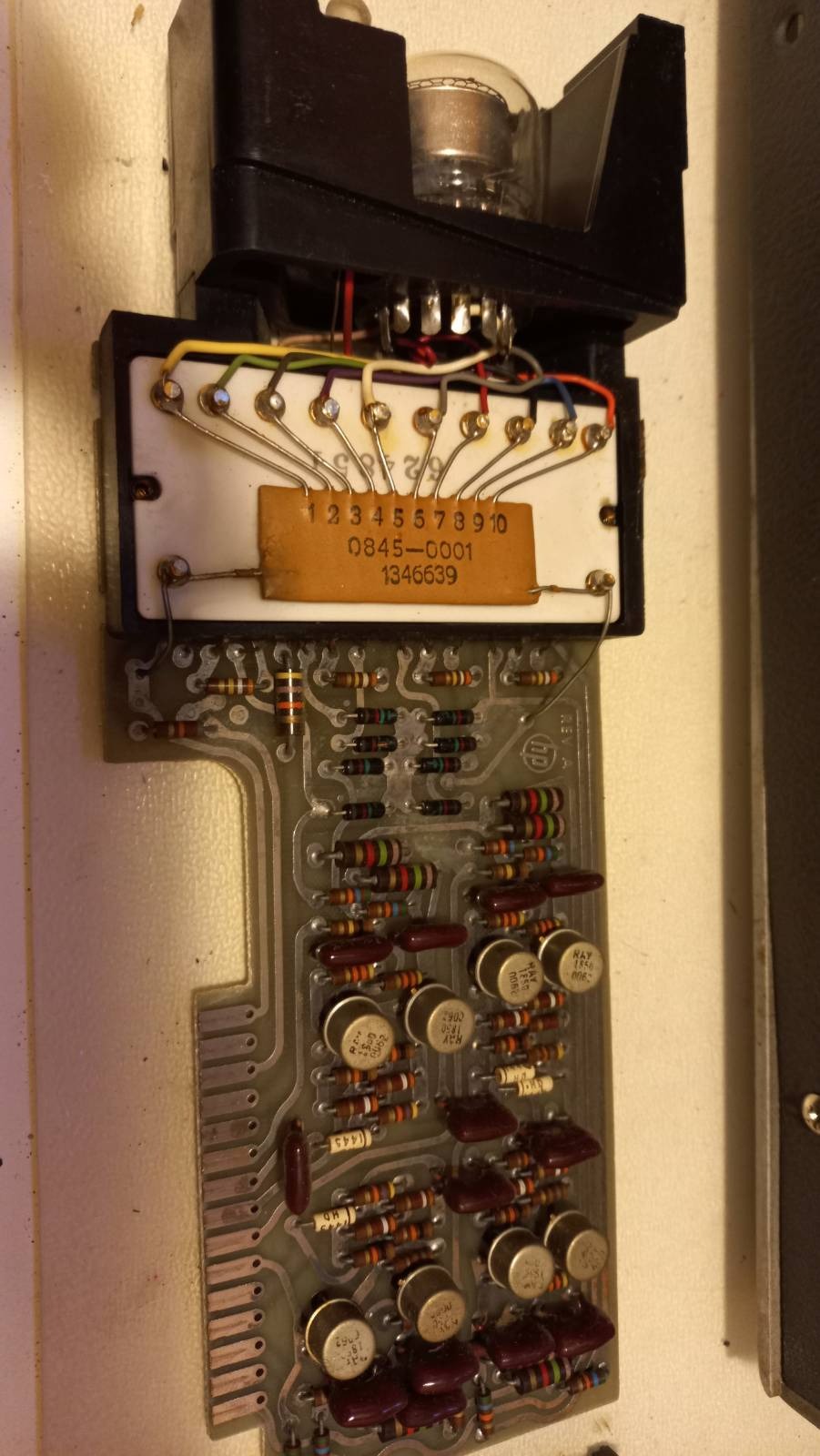
HP 5512A-4A display boards

Each Nixie is mounted on a removable board. The concept of this 3734A is similar to HP 5212A, 5512A, 5232A, 5532A counters from the same lustrum (1960-1965) as they share the display architecture. Earlier 5512A had the option to install a board with 10 neon lamps or with the "inline" indicator (a Nixie).

I will look for a manual of these other devices to grab an idea of the circuit diagram.


HP 5512A-4A insideEach display board uses a mix of transistors and a rudimentary integrated circuit as visible in the last picture (click to enlarge as usual).


Next step is to remove all boards and try to straighten the case.


21 July 2022

SGS integrated circuits H100/H200 series

Shortly after posting about H 257 and H 258 never-seen-before(-by-me) ICs, I tried different search keywords and a datasheet popped up from the back of Internet.

According to that document SGS-ATES produced a series of High Level Logic I.C.'s designed specifically for applications in areas where noise is a hazard. The supply voltage is from 10.8 to 20V and they are compatible with MOS technology:


From the datasheet you learn that the suffix D1/D2/D6/B1 distinguishes between voltage+temperature range and case material. I think it was 1970-1975. Afterwards SGS should have adopted the standard naming for their IC line-up.

As already stated, contact me if you need those chips (H 257, H 258, H 202, H 203).


14 July 2022

Integrated circuits SGS "H 258 B1" and "H 257 B1"

One of the Nixie boards I bought in FN Ham Messe 2022 does not use the usual 7441 Nixie driver + 74xX Latch combo, but rather some undocumented SGS "H 258 B1" and "H 257 B1".

The pinout of H-258-B1 BCD(?)-to-Nixie driver is different from similar documented components (see http://madrona.ca/e/nixieref/index.html for a comprehensive description), so it is worth reversing it from this simple PCB.

I shot a picture of both sides of the board and created a single Xray-like view using an image manipulation software (The GIMP) as I've done in the past. This is the result and a zoomed view of one pair of these ICs:

Both sides of the board with SGS chips.


SGS H257 and H258 combo.


The resulting pinout for H 258 B1 is:

1   input
2   input
3   input
4   digit 2
5   digit 3
6   digit 7
7   digit 6
8   GND
9   digit 4
10  digit 5
11  digit 1
12  digit 0
13  digit 8
14  digit 9
15  input
16  +V

I have no idea and no interest to discover which technology SGS used in 1974 for these parts. I will not use them in any of my projects because I would have no spares or direct replacements.

If you land here looking for a replacement, then contact me.


30 June 2022

Tune-a-Lite gas filled tuning indicator

I learned about gas filled tuning indicators in the last month, as I started reading through an Italian forum packed with information on restoration of old radio receivers ("Elettroni al tramonto"). They were used before the introduction of magic eyes, so approximately from 1930's to 1940's. It is like a shorter IN-9 or IN-13 tube. On radiomuseum there is some documentation: look for Tune-a-Lite. Of course it ended up in my "to look for" mental list.

I was very lucky as I found one at Friedrichshafen Ham Messe 2022 on the stall of a German seller that deals with vacuum stuff. I tested the component for leaks with my magic wand neon tester, which surprised two more sellers in the same day. Given the presence of neon inside, it came home with me.

On the mentioned forum there are few diagrams showing how to wire the indicator so I tried the setup while swapping the three terminals, since the pinout was unknown. Moreover, since it behaves like a Nixie, as long as the current is limited (to 1 mA) you cannot damage it.

So it did light up. The picture shows a zero, middle and full indication, plus the look from behind the slotted metal window/support.


tune-a-lite gas filled tuning indicator  

Zero, middle, full extension.


And this is the wiring layout of my specific part. You may use it as a starting point in case you come across a similar indicator mounted on its base:

tune-a-lite wiring diagram
Wiring diagram.


23 June 2021

Tortona, 20 giugno 2021

Last Sunday I attended a ham/electronics flea market after 9 months of lockdown, with the open-air location taming the smell of dust, vintage gear (materials, components, grease, ...) and the occasional (unintended) lack of personal hygiene caused by the very hot days. The whole feeling was very positive!

A side view of the location. We were trying the optical QSO on the grass.

For the second consecutive year I have been able to attend the fair in Tortona, which is held in a parking lot under the June Sun. There were approx. 20 tables, with lots of space for chatting, moving around, digging into the boxes. I could recognise a couple of "new entries" amongst exhibitors, that are heirs of SK, which sold some stuff unseen in previous editions.

I went there to meet friends, attempt an optical QSO with Mauro IK1WVQ and deliver the heavy and bulky Tektronix R7603 oscilloscope.

I came home with a N.I.B. Philips DP7-32 CRT (dual color, dual persistence), the Nixie display board from a Rohde&Schwarz EK47 receiver (7 sockets for six ZM1182 tubes, five of which still working), a new 250 MHz probe (for the no-oscilloscope that I have :)), some coax connectors, few large VFD and a board with LED displays.

It was not possible to complete the QSO because my optical transmitter used inefficient LEDs as opposed to Mauro's blindingly TX head, and I had not built the FM modulator. Too bad, because we had a whopping 100 metres in full daylight and his setup had a lot of margin!


10 June 2021

Early digital scale with Nixie tubes

Italiana Macchi Mach 55
Until 6 months ago I had no idea that in early 1970's existed digital scales that displayed information with Nixie tubes. That was the beginning of the transition from "analog" to digital weighting at retail shops.

In mid-2020 I saw one scale for sale on eBay which sprung my curiosity. It was a Italiana Macchi model "Mach 55". Not much has been written on Internet about these quite rare devices, and the most comprehensive discussion so far was on tubeclockdb forum from year 2012-2016.

Those devices were probably obsoleted in a decade and their resilience to time travels was heavily affected by their inherent weight.

Considering that a Mach 55 contains about 30 Nixie tubes, I had to own one: the hunt began, for this or similar models (which consists of setting up alerts on online marketplaces). One condition turned out to be compulsory: the scale for sale has to be picked up in person because it weights 30 kg or more!

By the way, Italiana Macchi (Italian) and Bizerba (German) are still active in the weighting sector!

24 April 2021

SEPTANIX Display from JRC

On the popular auctions site I spotted a never seen before(*) calculator that caught my attention. 

(*) most calculators stay on the site forever and nobody is interested in them (or they are proposed at a stellar price), so they fill up my saved searches and I skip all of them.

Even if a bit blurry, a picture of the display showed a think dense grid on top of the usual 7 segment + decimal point layout. With a bit of searching I could confirm it was a rebranded Unitrex 1202M, which came with a multi-digit gas-filled display but not a Burroughs panaplex.

Within a week I could get the calculator on my desk and reach the display:

septanix display by JRC
SEPTANIX Display with visible anode grid.

That is a (probably uncommon) SEPTANIX display made in Japan by JRC. It is a multi-digit version of other Japanese 7-segment neon tubes, with a visible anode grid as opposed to the more discreet arrangement in Panaplex display. Also vertical segments in the SEPTANIX have the same length, while in Panaplex lower ones are a bit taller.

The calculator itself is using negative voltages for the logic, so a conversion into a clock would require some extra efforts. Nevertheless I have one more display in my collection.


09 September 2020

Western Electric 6167 Dekatron

I am always alert on vintage display technologies and the latest common thread has started in mid-July 2020 at the first ham/electronics flea market after COVID-19 lockdown.

In Tortona open-air fair I found a Philips DG7-32 cathodic ray tube probably NOS and an 0D3 gas-filled cold-cathode tube. Having a CRT calls for a CRT clock, so I looked around for circuits and other CRTs for you-never-know-what-when. A small stock of National 2BP1 was on sale almost locally and the same guy had recovered a shoebox of NIB vacuum tubes (more on another post).

I poked around the unknown-to-me part numbers and gave them a meaning with the help of the smartphone. Amongst others, I took home a mysterious Western Electric 6167 Dekatron new in box, packed way back in 1958. The picture shows the original packaging, with a now sticky wax(?)+net foil and lots of soft paper. 


A dekatron is a counting device, or divider if you prefer. It is gas filled like a Nixie and some of them display a dot on the current count position. A datasheet is available, but no reference to original applications and circuits. Fortunately someone has already built a spinner with W.E 6167 so it was a matter of replicating the circuit.

Since everyone's junk box and equipment is different, I kept voltages from threeneurons's spinner circuit as a reference and generated them with two power supplies in series: 280V + 170V (make sure the second PSU is floating with respect to earth!). In order to get about 225V I used a sequence of zener diodes, which also provides a comfortable tap at about 60V. Finally, lacking a socket I used pins freed from a DB25 female to interface with the dekatron without stressing the pin-glass seal.

So, thanks to Mike "threeneurons" open work, this baby started spinning right away:


I like its un-usefulness  :)


29 August 2020

Neon Tester TS-990

My neon/nixie/gas-filled-tube tester homemade 5 years ago still works, but it is cumbersome to carry the device and a 12V battery when you need in on the field (A.K.A. flea markets...).

Instead of looking for a different case and fit a LiPo+booster, I decided to buy the TS-990 Neon Tester, that has a comfortable case and works off 4xAA batteries. Hard to beat at 10€/12US$!

Size is about the same :)


I did not expect it to pulse on/off the HVAC every second, but that helps to see the gas in daylight. Also it is more powerful than the CCFL inverter, as it lights up the gas even without touching the tube glass.


24 April 2020

Blue dot and leg glow in Z520M Nixie

I love Nixie tubes, and I especially love round top-view ones. Perhaps that is because the first ones I bought were of this kind.

Lately I got one Z520M with the red coating quite damaged (pictures seem to make it look even worse!). Since the red coating can be restored/replicated, I proceeded to test the tube. I was not surprised to find out that it needs to be driven a bit harder than newer Nixies, both because this one is quite old and probably it has been used a lot.

Digits 0 to 2 were behaving normally. When pulling low other digit cathodes only the leg was glowing. If left ON for few minutes the glow transferred to the digit from the area close to the pin. Unfortunately if the digit is switched off for a while the malfunction comes up again the next time the same digit is lit.

Now that I own a variable HV power supply I could experiment with the current through the tube, and saw that the "leg" does not glow if the current flow is lowered closer to the datasheet value. Even 0.1 mA makes a difference. But then the digit is faint or not completely lit (like "5" and "7").

Since the red coating is cracked I could see through the plain glass and note that the leg glow releases the infamous blue dot. It is caused by mercury and overcurrent. Since it does not happen on digits 0-1-2 it could be just a deposit on unused digits/wires and might be cured throughout hours of operation of the same symbol. Perhaps. I will not go further and keep the tube as-is in the collection. (Or make a test harness where I can leave it running for days out of the way in the lab?)

Can you see the infamous blue light through the crack in the coating?


15 April 2020

Another HV DC power supply

DISCLAIMER. This "project" handles lethal voltages and currents. Do NOT replicate. I take no responsibility for any damage that might occur from replicating or imitating what is illustrated below.

Having lots of time to spend at home to do "whateveryouwant", I started to clean the lab: move stuff around, make room on the desk, prepare a trip to the recycling facility, see stuff under a different light.

I happen to have two 12V power supplies from 1980's, when heavy transformers were dominating the scene and guaranteed RF silence. The first purchase was 12V/2A, then upgraded to 12V/5A (not that I cared about RF noise back then in my CB years!).

Both power supplies, as of April 2020.
They took space in the lab, one partially broke, one was recently upgraded with a step-down converter in place of 7812 so, as the headline suggests, I made a high-voltage DC power supply out of them.

What was (left) inside. Dust included.

D-C rectifier and back2back trafo.
How? I wired the two transformers back-to-back and rectified the AC output. Bonus, since transformers were both centre-tapped, I can select two outputs just by switching the intermediate connection: 170V or 340V. And both transformers fit into one original case!

According to transformer ratings I should be able to draw about 100-120 mA at 170V and half of that at 340V. Then the voltage drops, transformers vibrate and overheat.

The transformer receiving the mains is the bulkier one, from the former 12V/5A PSU, so there is some room for a low voltage output with decent current.

Final look, with HV output yellow/black.
Needed improvements:
  • fuse the AC input
  • fuse the HV output
  • add a damping resistor on the HV output
  • attach the HV output selection switch to the case 
  • add a status LED/lamp
  • add the low voltage output circuit
Unloaded 340V.
Unloaded 170V.

14 January 2020

Voltage multiplier

It is all right at IK1ZYW's Labs, it's just that I had no opportunity to update the blog.

Last experiment has been a voltage multiplier as Cockcroft-Walton designed it in mid 1930's. Why? Apart my quest for a HV PSU (in the order of 300 Vdc), Xmas lights came with powerful 24 Vac 20VA transformers that should be enough to power some Nixies, once voltage-multiplied.

Electro-party!
The hardest part has been to locate high value capacitors with high voltage rating in and around the junk box. While 2-300V rating is not hard to come by, the high capacitance is required in order to keep low its AC resistance at 50 Hz. Diodes need to sustain at least 60V reverse polarity, so 1N4003 and above.


I started with 220 uF capacitor, but it got too warm. Then I replaced it with 2200uF 63V in the first stage and everything got better. With 4 diodes I reached more than 160 Vdc which happily light up an IN-14 Nixie without dropping more than a Volt.

Nice experiment so far. A final circuit would allow to pick different output voltages stepped at (24*1,41) Volts, which can be useful.

Or just put back-to-back two of these transformers, rectify the output and find a way to drop it to the desired value. Thinking ...

15 February 2019

Weird behavior of ZS-042 RTC modules (DS3231)

First of all: all these ZS-042 RTC modules were paid about 1 USD each and come from not-certified sources. 

One night I decided to measure the 32K output of some DS3231 ZS-042 RTC modules. I wanted to see what difference would make if I retouched the aging register. This experiment lead to few unexpected discoveries.

1) Maxim DS3231 datasheet mentions 32K output and 32.768 kHz interchangeably. Alright, it is a digital device, so 32K equals 32768 if K=1024 as used for bytes. But we are talking of Hz, not bytes, so I think should be K=1000. Proof? Search for "768" in the datasheet.

2) There are two quite different devices that share 6 characters of the part name - DS3231 - and are distinguished by their suffix: M or SN. The former "M" is 5 ppm with MEMS resonator, while the latter "SN" is 2 ppm with TCXO. In simple terms, "SN" is better than "M". But you can't choose when buying ZS-042 modules and you will receive either model

"M", "SN", "M":notice the deeper blue PCB of "SN"
3) All my ZS-042 modules with DS3231M output a frequency close to 32.700 kHz, while those with DS3231SN are close to 32.768 kHz. The "M" would be loosing 180 seconds/day, 1.5 h/month, but none of them does! Actually I have one DS3231M in my longest running Nixie clock and it is within 5 ppm specification.

Measuring "32K" output of DS3231M.
So, let's forget DS3231SN that are most likely second-hand/pulls but legit. How can a DS3231M that outputs 32700 Hz be so accurate as I observed? If it is genuine, Maxim has a way to calibrate the chip once, before it is sold. If it is a fake, then it is microcontroller with proper firmware and calibration to count the correct number of interrupts. I could sacrifice one and decap it, but then I lack the microscope to examine the silicon die.

Conclusion. Buy the DS3231SN if you need an interrupt rate of 32768 Hz. Otherwise for hobbyist use, they are both worth it.

05 January 2019

Taking control of HP 9403A

The HP 9403A odyssey might be close to an end. After tracing most connections on the "DVS Program I/O" connector to corresponding ICs, thus understanding if they are inputs or outputs (they all end up into an HP 1820-0107 level adapter), I begun to take control of the device:

HP 9403A: first signs of human control after 40 years.
I know which are control lines and which are data lines. There is no serial protocol, but just plain parallel negative logic. If I want to do something with the bulky piece of equipment I will need a microcontroller with lots of I/O lines, or some serial-to-parallel (open collector) converter.